

FEPE is the voice of the industries it represents, at EU level.
We keep our members informed about changes affecting them.
We support networking and competition between our member companies.
We communicate our members’ opinions to the relevant EU institutions in Brussels.
We advocate on behalf of our members in the face of changing business practices and legislation.
Our goal is to ensure that the legislation is in the best interests of all our stakeholders, from our members to the public.
Areas of interest
Topics of concern to our members include any legislation impacting the envelope, light packaging and mail/distribution sector. This includes but is not limited to:
digitalisation and e-invoicing
data protection
postal affairs
citizen/consumer rights
environmental affairs.
Some of the issues we follow and are active in are described below.
Key Developments Affecting Envelopes and Light Packaging
Over recent years, EU legislation has increasingly shaped the regulatory environment for envelopes and light packaging. In 2024 and 2025, several major legislative files reached decisive milestones, moving from political negotiation into implementation, clarification, or reassessment. Throughout these processes, FEPE actively engaged with EU institutions to ensure that the specific characteristics of envelopes and flexible packaging were correctly understood and reflected.
Packaging and Packaging Waste Regulation (PPWR)
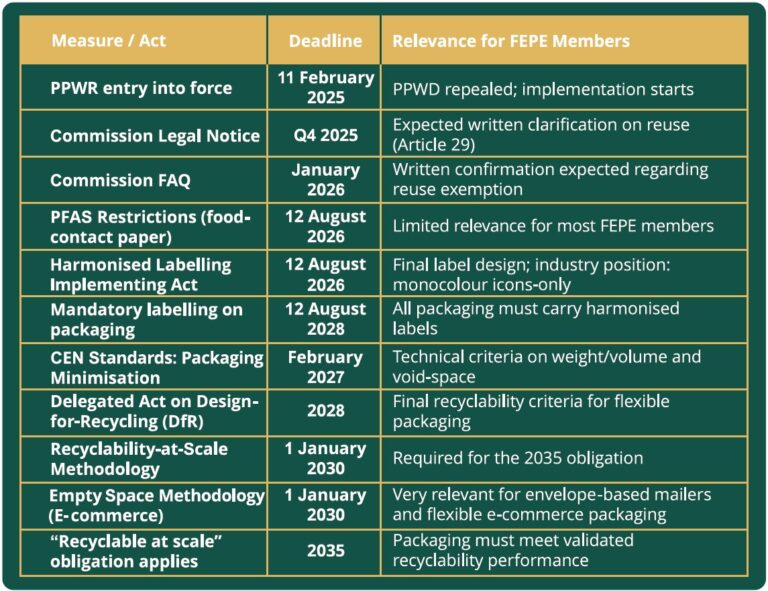
The Packaging and Packaging Waste Regulation (PPWR) entered into force on 11 February 2025, replacing the former Directive and launching a long implementation phase extending to 2035.
A key achievement for FEPE and its members is the clear exclusion of envelopes from the scope of the PPWR, safeguarding their role as an essential communication product for citizens and businesses. This outcome reflects sustained engagement with the European Commission and confirms that envelopes are not considered packaging under the Regulation.
Paper-based flexible packaging is well aligned with the PPWR’s objectives on circularity, recyclability, packaging minimisation, and empty-space reduction, particularly in the context of e-commerce. FEPE also represents converters working with other flexible materials and therefore continues to follow technical developments closely to ensure that future rules remain practical, proportionate, and science-based for all members.
The interpretation of reuse obligations under Article 29 has now been clarified in substance. It is confirmed that paper-based flexible packaging, is out of scope of the reuse obligations set out in Article 29. This reflects the shared understanding that these formats are not suited to reuse schemes and should not be subject to reuse quotas. While FEPE continues to monitor the publication of supporting Commission guidance for completeness and legal certainty, the underlying position is now clear and provides regulatory confidence for converters and operators.
Beyond reuse, FEPE remains actively engaged in monitoring the development of delegated and implementing acts on design-for-recycling, harmonised labelling, packaging minimisation, empty-space rules for e-commerce, and the interpretation of composite packaging criteria, all of which will influence future design choices and investment decisions.
EU Deforestation Regulation (EUDR)
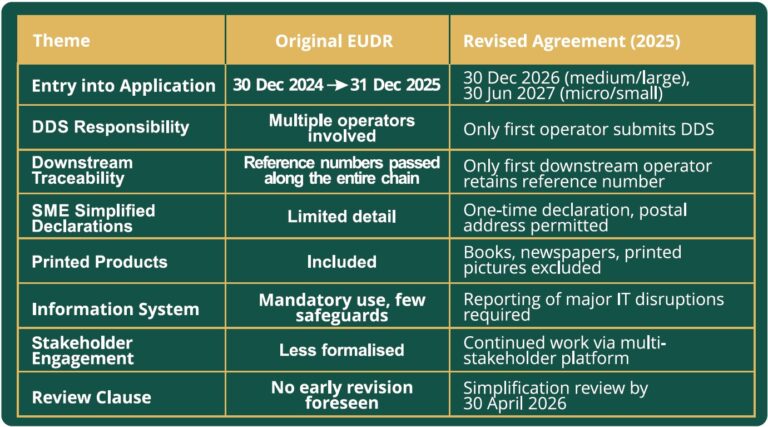
The EU Deforestation Regulation (EUDR) underwent significant revision following widespread concerns about administrative complexity, unclear obligations, and an unrealistic implementation timeline. These concerns led the EU institutions to reopen the Regulation for targeted correction and simplification.
In December 2025, the European Commission, Parliament, and Council reached a political agreement introducing substantial improvements. The revised framework limits the obligation to submit a Due Diligence Statement to the first operator placing products on the EU market, reduces downstream traceability requirements, and postpones the application date to 30 December 2026 for medium and large operators and 30 June 2027 for micro and small operators.
An important clarification was also confirmed regarding scope. Printed products classified under HS/CN Code 49, where the essential value lies in the printed content, are excluded from the Regulation. Envelopes, classified under HS/CN Code 48, remain fully in scope of the EUDR. This distinction is essential for correct compliance planning across the value chain, including upstream suppliers of paper and materials.
Overall, the revised EUDR represents a shift towards a more pragmatic and risk-based framework. FEPE considers this direction encouraging and will continue to closely monitor implementation, including the mandatory simplification review scheduled for 2026.
Green Claims Directive
The proposed Green Claims Directive, intended to introduce a pre-verification system for environmental claims, did not progress as planned in 2025. Following the collapse of trilogue negotiations and strong political opposition—particularly regarding the administrative burden for SMEs—the European Commission announced its intention to withdraw the proposal. While not formally repealed, the initiative is effectively on hold, with no clear path forward at this stage.
Despite this pause, enforcement against misleading environmental claims continues under existing EU legislation, notably the Empowering Consumers for the Green Transition Directive, which already prohibits unsubstantiated or misleading claims. FEPE supports proportionate, evidence-based sustainability communication and remains cautious regarding any future initiatives that could introduce unnecessary bureaucracy.

Environmental affairs legislation
FEPE is interested in any environmental-related legislation that may affect our members and stakeholders. One example is the EU Ecolabel.
The EU Ecolabel was established nearly 30 years ago. It has included specific criteria for “converted paper products”, including envelopes, since 2014. The EU Ecolabel works in accordance with the ISO standard 14024 and is therefore a Type I label, one of the most reliable ways to communicate environmental information to consumers.
For more information, see the European Commission’s EU Ecolabel website or contact the FEPE Secretariat.
See also: Sustainability

Data protection legislation
EU data protection rules – notably the EU General Data Protection Regulation (GDPR) – guarantee the protection of your personal data whenever they are collected.
GDPR protects citizens because the requirements for collecting, storing and using data are now much stricter. Companies and organisations are more restricted in how they can use data for business purposes. GDPR affects both online and physical, direct mail communication.
FEPE supports the view that personal privacy is of paramount importance and a basic right for all European citizens.
However, it’s also important to enable consumers to get easy access to marketing messages of interest to them. And to enable companies and organisations to use data for legitimate business purposes.
Data protection issues are of particular interest to FEPE members involved in producing materials for direct marketing.
We therefore advocate for a balanced approach to data protection legislation to ensure that:
- consumers’ personal data are protected, and
- consumers get access to a wide range of marketing materials, enabling them to choose, and
- businesses are able to inform customers of opportunities available to them, and
- businesses can establish and maintain a long-term relationship with their customers.

Information access legislation
The world is becoming more digitalised. This transition brings all of us many new opportunities. However, not everyone has equal access to these opportunities. For some people, the digital world is not yet fully accessible. For others, it is not affordable. Others do not have the skills to participate fully – some people can learn those skills, some cannot.
Digital inclusion is an EU-wide effort to ensure that everybody can contribute to and benefit from the digital world. It is largely focused on accessibility and social inclusion to make internet more accessible to the greatest number of people. Because all EU citizens have a right to “full participation in society, on an equal basis with others.”*
* EU, Union of Equality: Strategy for the Rights of Persons with Disabilities 2021-2030
Realistically however, people in very remote communities, marginalised individuals and communities, and people with disabilities are unlikely to benefit from digital inclusion efforts for a long time to come.
Again, FEPE advocates for a balanced approach to information access legislation to ensure that:
- digital inclusion helps to provide access to the digital world to the greatest number of people, and
- citizens retain the right to choose to access information by non-digital means, on an equal basis with people who choose digital access.
It will take considerable time and investment before everyone has equal access to internet communication. In the meantime, there are many people who need continued access to non-digital communication, including the right to receive information (e.g. bills, private or confidential communication, etc.) by post, and widespread, reliable postal services.
Read more about our activities related to Paper-based communication.